
This article is general wellness education, not medical advice. If you have symptoms, a medical condition, medication questions, pregnancy-related questions, eating-disorder concerns, or pain that changes your daily life, talk with a qualified health professional.
Choose one small act of care each day, leave room to skip, and finish by keeping only what helped. These 12 days of self care are an editable sequence for ordinary life or a crowded holiday period. There is no purchase list, perfect streak, or promise that twelve activities will change your health.
Start with the day you actually have
Pick a starting point that suits your responsibilities. You can begin in December, after a demanding week, or on an unremarkable Tuesday. The day numbers give the plan a shape; they do not set a deadline. If illness, caregiving, work, or exhaustion interrupts it, move an activity or leave it out. You do not owe the plan a catch-up session.
The editor above lets you choose a day, replace its suggested activity, enter a time allowance, and mark it planned, done, or skipped. Save each change before choosing another day. The copy field contains your current saved plan. Copy it somewhere private before closing this tab: the editor does not save between visits or send your notes anywhere. Avoid putting sensitive health details in a shared device.
All time suggestions below are editorial planning choices. They are not clinical doses, exercise targets, or a measure of how much care you deserve. Choose zero minutes for an untimed action such as declining an optional request. The editor accepts whole minutes from zero to thirty simply to keep this particular plan small. Longer care needs remain valid outside its scope.
Days 1–4: make a little room
Day 1: name one thing you need
Write one sentence: “Today would be easier if…” Finish with something concrete, such as a quieter lunch, a clear place for tomorrow's bag, or help with an errand. Choose one response that is within reach. If you cannot change the situation today, naming the need is enough. You can leave the action untimed.
Day 2: clear one useful landing spot
Spend up to five minutes making room for something you use every day. Clear a chair, the corner of a table, or a small section of the counter. Stop when that spot works. A whole-room cleanup is not required. If tidying feels like another obligation, replace this activity with sitting somewhere comfortable for a few minutes.
Day 3: give one meal your attention
Choose a meal you were already going to eat. Set aside one distraction if circumstances allow, then sit and eat without adding a new food rule. This is a pause in the schedule, not a diet task. If meals are difficult for you, choose another activity and follow any individual guidance from your care team.
Day 4: make tomorrow's first step easier
Put one needed item where you will find it, write the first task on a note, or check the time of an existing appointment. Choose a preparation task that takes about five minutes. When it is finished, leave the rest of tomorrow alone. Readers who want a separate morning sequence can use our gentle morning reset.
Days 5–8: choose what fits
Day 5: enjoy a comfortable change of pace
Choose an activity you already know is comfortable for you: a short walk on a suitable route, a little gentle movement, or an equally valid seated rest. Keep it optional and within your own limits. There is no step count or intensity goal in this plan. Stop an activity that hurts or makes you feel unwell, and seek appropriate medical advice when needed.
Day 6: contact someone safe
Send a brief message, arrange a call, or ask for practical help. A useful message might be: “Could you pick up that parcel when you are nearby?” You can also write a message without sending it until you are ready. Skip contact that feels unsafe or demanding. Connection does not require answering every message in your inbox.
Day 7: set one small boundary
Look for an optional request you can decline, delay, or make smaller. Try a plain sentence: “I cannot do that this week,” or “I can help for ten minutes.” You do not need to rehearse a confrontation. If you cannot safely change a commitment, pick another activity instead. The point is to choose a workable action for your circumstances.
Day 8: return to something you like
Read a few pages, listen to one song, sketch, or spend a little time on an existing hobby. Use what you have. No new equipment, subscription, or self-care purchase is part of the plan. Choose an activity because you enjoy it, even if it leaves nothing useful to show afterward. Ten minutes is a possible starting allowance, not a requirement.
Days 9–12: notice and keep
Day 9: soften one evening decision
Decide when to stop one optional task, put tomorrow's necessities together, or set aside a quiet activity you enjoy. Choose the part you can influence without cutting into needed rest. This is not a sleep treatment, and a completed checkbox cannot tell you whether you slept well. A separate evening wind-down plan can help you think through that routine.
Day 10: record something specific you appreciated
Write one ordinary detail you appreciated: a conversation, a useful favour, a pleasant view, or a meal someone prepared. You do not need to feel grateful on command. If this prompt feels forced, record something you noticed, or skip it. Honest notes are more useful here than a performance of positivity.
Day 11: ask what made care harder
Review one saved entry. Was the activity too long, badly timed, expensive, inaccessible, or dependent on someone else? Change the practical condition before blaming yourself. For example, replace a long outing with a short nearby pause, or move a call to a time when both people are available. Keep the adjustment small enough to explain in one sentence.
Day 12: keep one thing and release the rest
Choose one activity you would willingly repeat. Name its cue: “After lunch, I will step away from the screen for a few minutes,” or “On Sunday, I will check whether I need help with errands.” You may also decide that none of these activities fits. The closing review is a choice about your next plan, not proof that the challenge worked.
Use the sequence without turning it into a score
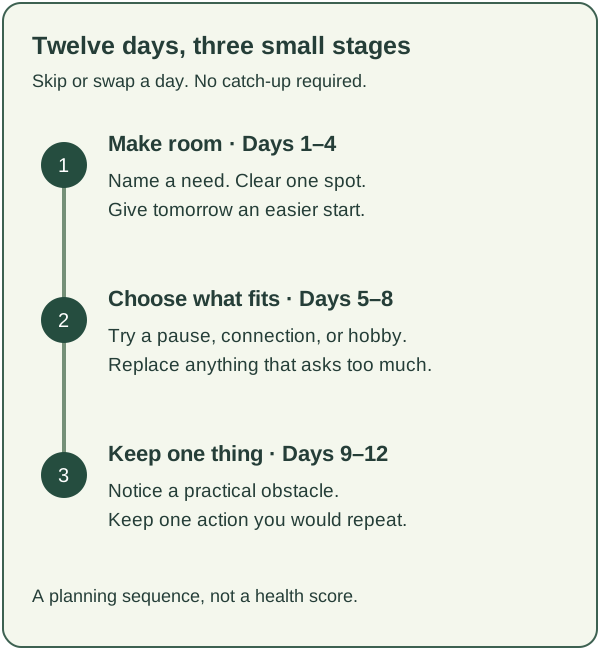
The three stages are a way to organize choices. Days one through four make space, days five through eight try different options, and days nine through twelve review what belongs in your routine. You can swap the order. A family gathering might make a boundary useful on day two; a difficult week might mean returning to the first prompt several times.
The editor counts entries marked done, entries marked skipped, and entries still planned. Its minutes total includes planned and done entries, while skipped entries contribute zero. That total is a scheduling figure only. It does not measure wellbeing, effort, health improvement, or whether you have done enough. Editing a completed day replaces its earlier entry; it never adds a second copy.
If you miss several days, choose your next useful action and carry on. Do not double the following day's workload. If the sequence becomes another source of pressure, stop using it. For shared households, each person should choose their own actions and boundaries. Another person's completed count is not a useful comparison.
What the sources support—and where this plan stops
The National Institute of Mental Health's self-care guidance discusses everyday choices involving priorities, enjoyable activities, sleep, and supportive relationships. It also emphasizes that individual needs differ and encourages professional help for concerning symptoms. Our twelve-day order, optional time allowances, and editor are original planning aids; NIMH has not evaluated or endorsed this sequence.
This article offers general wellbeing ideas. It does not diagnose, treat, or replace individual medical or mental-health care. If symptoms are distressing, persistent, or interfering with daily life, contact a qualified professional rather than waiting to finish the twelve days. If you may be in immediate danger, seek urgent local help. A small routine can sit alongside appropriate support, but checking off activities is never a condition for asking for help.